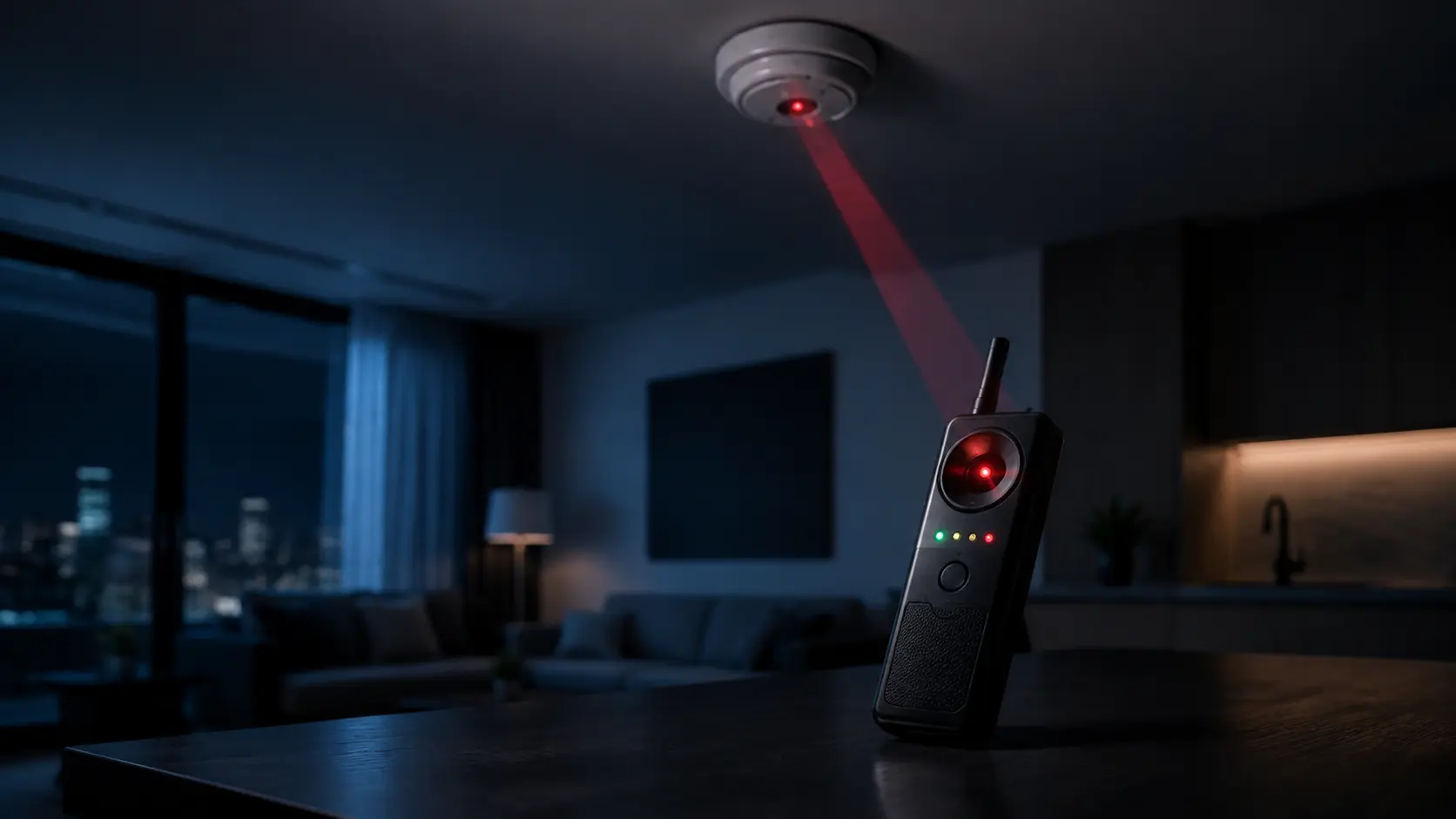
Privacy is not only about passwords and data on a computer. It also concerns the spaces where we live, work, sleep and discuss personal or confidential matters. A hidden camera, an unauthorised microphone or a tracker fitted to a vehicle can turn an apparently ordinary space into a source of information for someone else.
For this reason TekCare360 is developing the Privacy Check service: a technical, considered check of spaces designed to identify unusual signals, possible hidden lenses and devices that deserve closer inspection. It is not a promise from a spy film and it is not a zero-risk certification: it is a practical check combining tools, observation and method.
What is a Privacy Check?
A Privacy Check is a preliminary analysis of a space or asset, such as a home, hotel room, office, meeting room or vehicle. The goal is to look for elements that do not belong in the context, unusual radio transmissions or objects that could hide a lens, microphone or tracker.
- Visual observation of objects, sockets, detectors, lamps, clocks and furnishings
- Search for radio signals in the space
- Optical check for possible hidden lenses
- Search for magnetic fields that may, in some cases, be associated with trackers or concealed devices
- Assessment of the results, distinguishing known sources from anomalies requiring further investigation
The role of the K68 in the check
The K68 is a portable support tool that can combine several search modes. The exact functions may vary by device version, but typical use includes detecting RF activity, visually searching for lenses and checking magnetic fields.
RF signal detection
RF mode helps identify radio activity in the space. It can be useful when a wireless device is transmitting through Wi-Fi, Bluetooth, a mobile network or other radio technologies. Signal level and sensitivity adjustment can help progressively narrow down the area to inspect.
An RF signal is not automatically a threat, however. Routers, phones, smartwatches, access points, smart-home devices and other perfectly legitimate equipment can produce many readings. First establish a baseline, then isolate sources that are already known and finally assess anything that has no reasonable explanation.
Optical lens search
Optical searching uses the reflection of light on the lens surface. In a dimly lit room, slowly looking through the device's viewing system, a lens may appear as a brighter point reflection than the background. It is a manual procedure: it requires attention, slow movement and the ability to distinguish a real reflection from an ordinary shiny surface.
Searching for magnetic fields
The magnetic function can help check metal objects, vehicles or difficult-to-observe points, especially when a small tracker attached with a magnet is suspected. Not all trackers use a magnet, and a detected field does not by itself prove that a device is present: here too, the result must be interpreted in context.
How a TekCare360 check works
A serious check is not about walking quickly around a room waiting for an alarm. Method matters at least as much as the tool: an organised scan reduces false positives and makes it easier to repeat the check or explain the result to the customer.
- Define the space to be checked and the reason for the check
- Gather information about devices that are already present and authorised
- Take an initial reading of the space before moving or switching off any equipment
- Perform a slow RF scan, progressively adjusting sensitivity to locate sources
- Carry out an optical inspection in suitable light, focusing on objects with an unusual position or shape
- Use magnetic checking where it makes sense, including vehicles or furnishings if requested
- Make a final assessment and identify anomalies requiring further investigation
When possible, we document observations and separate what has been explained by a known source from what remains anomalous and deserves further checking.
Where can it be useful?
- Homes and private rooms
- Holiday apartments and homes before guests arrive
- Offices, professional studios and meeting rooms
- Vehicles used for work or frequent travel
- Spaces where moved objects, unusual noises or unexplained technological behaviour have been noticed
The K68 is not an absolute guarantee
It is important to be clear: no small portable detector can guarantee that a space contains no hidden device. RF detection works when there is a detectable signal; a camera that is switched off, wired, shielded or configured to record locally may not produce a useful transmission. Optical searching, on the other hand, depends on the visibility and reflection of the lens.
- An alarm may be caused by perfectly legitimate equipment
- The absence of an alarm does not prove that there is no camera or microphone
- Distance, shielding, frequency and device state affect the result
- A tracker does not necessarily have a magnet or transmit continuously
- The device does not replace forensic analysis or action by the authorities
Authorisation, respect and handling the results
A Privacy Check must be carried out with the authorisation of the owner, person responsible for the space or person entitled to request it. It is not correct to inspect or open objects belonging to other people without consent. If something suspicious is found, it is preferable not to tamper with it: document its position, avoid altering potentially useful evidence and agree next steps with the customer.
A considered check is worth more than a simple alarm
The value of a Privacy Check is not only in the K68. It lies in combining preparation, observation of the space, knowledge of existing devices and cautious interpretation of the results. A tool can indicate where to look; experience helps determine what is worth investigating further.